
The 2026 California Home Services Marketing Playbook (HVAC, Plumbing, Electrical, Roofing & More)
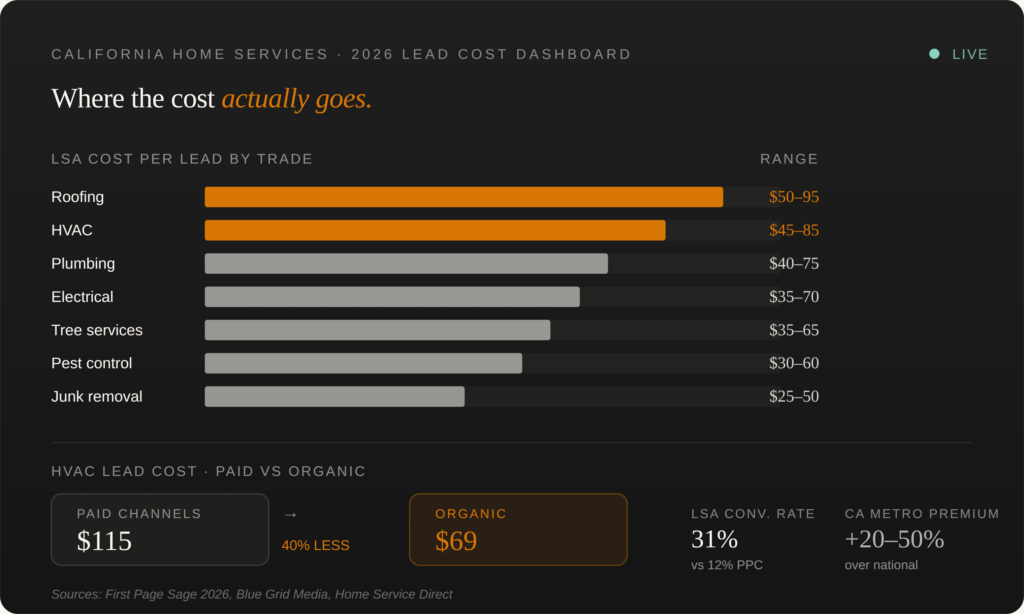
If you’re a California home services contractor, the 2026 lead generation landscape rewards a very specific approach. Cost per lead is up sharply across most trades, but the gap between organic and paid leads has never been wider. HVAC contractors in California now pay $115/lead through paid channels but only $69/lead through organic — and roofing leads can hit $130+ during storm season. Here’s the actual marketing playbook that works for plumbers, electricians, HVAC pros, roofers, tree services, pest control, and junk removal businesses across California in 2026.
The 2026 lead cost reality, by trade
Lead costs vary dramatically by trade and California metro. The numbers below are 2026 benchmarks aggregated across multiple sources for Google Local Services Ads (LSAs), which have become the dominant paid channel for home services.
Google LSA Cost Per Lead by Trade · 2026
What contractors actually pay per lead.
Two things to internalize: California metros run 20-50% above national averages, especially in LA, Orange County, the Bay Area, and San Diego. And storm season can double or triple roofing CPLs — a roofer paying $70/lead in January may pay $210/lead in May after a hailstorm. The numbers aren’t static.
Cost per lead vs. cost per booked job — the only number that actually matters
Most contractors track CPL and stop there. That’s the single biggest mistake in home services marketing math. Cost per lead is what Google charges you. Cost per booked job is what determines whether the channel makes you money. They are completely different numbers, and one tells the truth.
The Blue Grid Media 2026 LSA cost analysis illustrates this perfectly: a plumber paying $60/lead who answers 90% of calls and books 60% of conversations has a cost per booked job of about $111. Same plumber paying the same $60/lead but answering only 60% of calls and booking 30% — cost per booked job jumps to $333. Same ad spend, completely different economics. The variable isn’t the channel. It’s the operations.
Run your numbers
This calculator uses 2026 California LSA averages. Pick your trade, plug in your real numbers, and see what you’re actually paying per booked job — and what your return is.
Home Services ROI · Live Calculator
What’s a booked job actually costing you?
Leads / month
Booked Jobs / month
Cost Per Booked Job
Return On Spend
The five-channel stack that wins California in 2026
The contractors thriving in California right now don’t rely on one channel. They run a stack — and the stack is what makes them resilient when CPLs spike or one channel softens. Here’s what that stack looks like for a typical California contractor in 2026.
1. Google Business Profile — the unpaid foundation
The single highest-ROI marketing asset any home services contractor has is their Google Business Profile. Free. Complete profiles get 67% more profile views than incomplete ones, and GBP signals account for 32% of local pack ranking weight.
What “complete” actually means: primary category exactly matching your service (e.g., “HVAC contractor” not “Contractor”), every secondary category that describes a service you offer (water heater installation, AC repair, etc.), 25+ photos updated quarterly, services list with descriptions and prices where reasonable, accurate hours including holidays, attributes (license, free estimates, emergency service), and Q&A section seeded with the questions customers actually ask.
2. Local Services Ads (LSAs) — the fastest paid channel
LSAs are the dominant paid channel for home services in 2026 for one reason: they convert at 31% (lead to customer) versus 12% for traditional Google Ads PPC. The pay-per-lead model means you only pay when someone calls or messages — not for every click.
What separates contractors getting 40+ quality LSA leads per month from contractors burning budget: response speed (answer in under 60 seconds), profile completeness with the Google Guaranteed badge, review velocity, active lead disputes (15-20% of LSA leads are disputable for credits — and most contractors leave that money on the table), and tightly scoped service categories that match high-margin work, not everything you can possibly do.
3. SEO + content — the channel that compounds
The data on this is increasingly clear. First Page Sage’s 2026 industry report shows HVAC companies pay an average of $115 per lead through paid channels but only $69 through organic. For construction trades, the gap is $280 paid versus $174 organic. The contractors holding steady margins as paid CPLs climb are the ones who built organic presence over the last 12-24 months.
For home services SEO in California, three content types do most of the heavy lifting. Service-area landing pages (one real, substantial page per city you serve — not a list). Service-specific deep dives (one per service: AC repair, water heater installation, panel upgrade — each with FAQ schema, real pricing context, and trust signals). And local content that establishes you as a category authority in your metro (what permits homeowners need in your county, seasonal service guides, local case studies).
4. Reviews — the multiplier on every other channel
Reviews don’t just affect rankings. They affect click-through rate on every channel — LSAs, Google Maps, organic results, your website. A 4.8-star contractor with 200 reviews gets dramatically more clicks than a 4.5-star contractor with 50 reviews. Top-volume LSA contractors typically maintain 4.8+ ratings with strong review velocity, with some receiving 80-100 leads per day at that quality threshold.
The system that actually generates consistent reviews: built into your service delivery. Job complete → text message goes out same day with a one-tap link to your GBP review form. Train technicians to mention reviews verbally before leaving. The “we’ll email later” approach produces 5% review rates. The same-day text + verbal ask approach produces 25-35% review rates.
5. Email + SMS to past customers — the quietly dominant channel
Most California contractors completely ignore their existing customer database. This is the highest-ROI channel available to you. Email returns roughly $42 per dollar spent across industries, but for home services specifically, the math is even better because most past customers have ongoing service needs (HVAC tune-ups, plumbing maintenance, pest renewals, tree care).
The minimum viable system: a customer database with email + phone, a quarterly newsletter with seasonal service reminders, and a yearly “we miss you” campaign for customers you haven’t seen in 18+ months. Most contractors I work with discover that 25-40% of next quarter’s revenue can come from past customers if they bother to reach out. The marginal cost of those leads is essentially zero.
The 2026 California-specific playbook
LSA → Customer Conv.
31%
vs 12% for traditional PPC — LSAs convert nearly 3x better
Mobile Local → 24h Visit
76%
3 in 4 mobile local searchers visit a business within 24 hours
CA Metro CPL Premium
+20–50%
LA, OC, Bay Area, and SD run well above national LSA averages
For California contractors specifically, three plays consistently produce outsized results. City-level SEO targeting works because California metros are dense enough that “[service] [neighborhood]” searches have meaningful volume — “AC repair Brentwood” or “plumbing Capitola” are real money keywords with low competition. Most contractors target the metro level and miss the conversion-rich neighborhood searches.
Spanish-language content is dramatically underserved. Roughly 28% of Californians speak Spanish at home; the competition for Spanish-language home services keywords is a fraction of English. A simple “Servicios de Plomería” service page with proper schema and a Spanish-speaking phone option is often the single highest-converting page on a California contractor’s site.
Permit and code knowledge content establishes authority faster than generic service content. California’s building codes, permit requirements, and Title 24 energy regulations are complicated. A contractor who publishes clear, accurate content explaining what permits a homeowner needs for a panel upgrade in their county or what Title 24 requires for a new HVAC install becomes the obvious choice when that homeowner is ready to hire.
What good looks like in 12 months
For a typical California home services contractor running this stack consistently, here’s what realistic 12-month outcomes look like:
Months 1-3: GBP optimized, LSAs producing 15-30 leads/month at trade-typical CPL, review velocity climbing, foundational SEO work in motion. Most leads still coming from paid.
Months 4-6: Service area pages indexed and ranking for some long-tail terms, LSA optimization (lead disputes, profile improvements) lowering effective CPL by 15-25%, email/SMS to past customers producing first measurable revenue. Lead mix shifting: 70% paid, 30% organic.
Months 7-9: Top-3 rankings starting to appear for primary city + service combos, organic lead volume accelerating, review count past 100 with 4.7+ rating. Lead mix around 55% paid, 45% organic. Cost-per-booked-job dropping noticeably.
Months 10-12: Established organic presence in 2-3 California cities, LSAs running on optimized budget rather than max-spend, email/SMS contributing 15-25% of monthly bookings. Lead mix 40% paid, 60% organic. CPL on paid channels stable or declining despite industry inflation.
This isn’t theoretical. It’s what the math produces when a contractor commits to the stack consistently. The contractors who get stuck are the ones who run only LSAs and watch their CPL climb every quarter without an organic foundation underneath. The contractors who win build both at once — and by year two, they’re the ones holding margin while their competitors keep paying more for less.
Want a marketing plan built specifically for your trade and California city?
I’ll audit your current setup — GBP, LSAs, website, reviews, content — and send you a written report with the specific actions ranked by impact. Free, no pitch, written report you can keep whether you hire me or not.
Get a free contractor audit →