
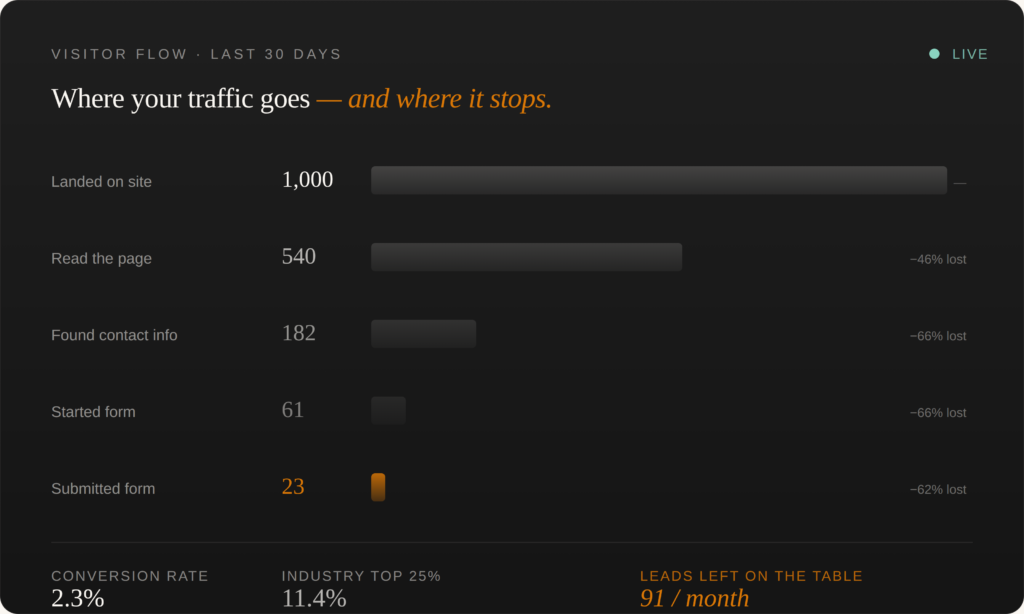
Here’s a stat I think about constantly: the average website converts 2.35% of its visitors in 2026. That means out of every 100 people who land on your site, 97 leave without taking a single action. No call. No form. No email. Nothing.
If your site gets traffic but you’re not getting leads, you’re not broken. You’re average. The good news: top performers in 2026 are converting at 11.45% — nearly 5x the average. The gap between average and excellent isn’t traffic. It’s a handful of fixable problems.
Plug your numbers in below to see exactly how many leads you’re leaving on the table.
Lead Recovery Calculator
How many leads is your site missing?
Your Conversion Rate
Leads Left On The Table / Year
Compared to a top-quartile conversion rate of 11.45% — what well-optimized sites in your category are achieving in 2026.
That number probably stings. Good. Let’s get into why it’s happening — and what to do about it.
1. Your site is built for you, not your visitor
Open your homepage right now. What’s the first thing it says? If it’s “Welcome to [Your Business]” or “We are a family-owned company serving the Central Coast since 2003,” your site is the problem.
Visitors don’t care about you. They care about whether you can solve their problem. The first headline on your homepage should answer one question: Can this business help me with the thing I came here for? Everything else — the family story, the years in business, the awards — comes after.
The data backs this up hard. Personalized calls-to-action perform 202% better than generic ones. That’s not personalization in the technical sense — it’s just speaking to what the visitor actually wants. “Get a free quote on tree removal in San Luis Obispo” beats “Contact Us” every single time.
2. Mobile is an afterthought (but it’s where everyone is)
Here’s a stat that should be making local business owners panic: mobile accounts for 65% of website traffic but converts at only 1.82%, compared to 3.14% on desktop. The gap has actually widened since 2024.
If you serve local customers, mobile is even more critical. Someone searching “plumber near me” at 9 PM on a Tuesday is doing it from their phone, with one hand, while they wait for water to stop coming out of somewhere it shouldn’t. If your site loads slowly, your phone number isn’t tappable, or your contact form has 11 fields and an “Are you sure?” popup, that lead just went to the next result on Google.
Mobile-first isn’t a design philosophy anymore. It’s the basic minimum.
3. You’re asking for too much, too soon
Look at your contact form. How many fields does it have? Name, email, phone, company, how-did-you-hear, project type, budget range, timeline, message. If you’re nodding along, you’re not alone — and you’re hemorrhaging leads.
The math is brutal. Three-field forms convert at 10.1%. Nine-field forms drop to 3.6%. Every additional field after the third one is a percentage point of conversion you’re voluntarily throwing away.
Here’s the question to ask: of every field on my contact form, can I get this information in the first phone call instead? If yes, kill the field. The form’s job isn’t to qualify the lead. The form’s job is to start a conversation. You qualify in the conversation.
4. You’re giving them five things to do instead of one
Most service business homepages I audit have the same problem: too many calls to action, all competing for attention. “Get a quote” next to “Schedule a call” next to “Download our brochure” next to “Subscribe to our newsletter” next to “Follow us on Instagram.” When a visitor sees five options, they pick none.
Every page on your site needs one job. The homepage job might be “get them to request a quote.” The services page job might be “get them to call.” A blog post’s job might be “get them to download a guide.” Pick the one action you want, then make that action obvious, repeated, and impossible to miss. Everything else gets buried in the footer.
This is also why landing pages convert so much better than general website pages — median landing page conversion sits at 4.02%, almost double the 2.35% for general pages. Single-purpose pages convert. Multi-purpose pages confuse.
5. Your site is slow, and there’s no proof it’s worth waiting for
Two final issues that travel together: page speed and trust signals. People won’t wait for a slow site, and they won’t trust a site that doesn’t show evidence other people have.
On speed: a landing page with poor Core Web Vitals can pay 22% more per click than a faster competitor bidding on the same keyword. Google literally taxes you for being slow. And on the user side, every additional second of load time is a measurable bounce rate increase. The biggest wins typically come from image optimization, font loading, and killing render-blocking third-party scripts.
On trust: most local business sites have zero social proof above the fold. No reviews. No client logos. No testimonials. No photos of actual work. The visitor lands on the homepage and has no evidence anyone else has trusted you with their money. Why should they?
The hard truth: it’s not five problems. It’s one.
Look back at the five reasons. They’re not really five separate things. They’re five symptoms of one underlying problem: your site was built without a clear answer to what should this visitor do, and how do I make that as easy as possible?
That’s why one-off fixes rarely work. You can’t tweak your way from a 2% conversion rate to an 8% conversion rate by changing button colors. You need a site that’s built around a single conversion path, with every page, every form, every word working toward that one outcome.
The good news: this is a fixable problem. Every business I’ve worked with that committed to it has seen real, measurable changes — not in years, in weeks. The conversion math is simple: doubling your conversion rate from 2% to 4% doubles your leads from the same traffic. No new ads. No bigger SEO budget. Just a better site.
Want to know exactly where your site is leaking leads?
I’ll review your site, search visibility, and analytics — then send back a written audit with specific recommendations. No obligation, no pitch.
Get a free strategy audit →