
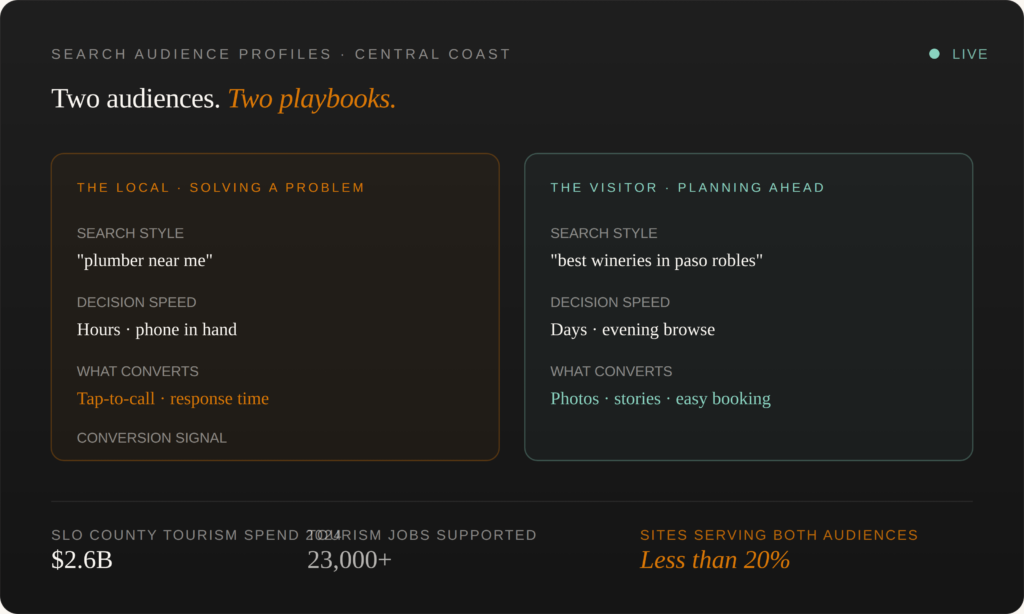
Tourism brought $2.4 billion in direct travel spending to SLO County in 2024 alone, supporting over 23,000 jobs. If your business serves the Central Coast, you have two distinct customer groups searching for you online — and they search completely differently. Most local sites are optimized for one and miss the other entirely.
The two audiences nobody talks about
When someone in SLO County searches for a business, they’re either a local with a problem to solve or a visitor planning an experience. These two groups have almost nothing in common in how they search, what they’re looking for, and what gets them to convert.
AUDIENCE A
The local solving a problem
- Intent: Specific, urgent, transactional
- Search style: Short, direct, often “near me”
- Decision speed: Hours or minutes
- Trust signals: Reviews, response time, locality
- Device: Phone, mid-task
- What converts: Tap-to-call, fast quote, “we’re 4 minutes away”
AUDIENCE B
The visitor planning ahead
- Intent: Discovery, comparison, anticipation
- Search style: Long, descriptive, experience-led
- Decision speed: Days or weeks ahead
- Trust signals: Photos, reviews, perceived authenticity
- Device: Phone or laptop, evening browse
- What converts: Storytelling, photos, easy booking
A plumber in Pismo Beach mostly serves audience A. A winery in Paso Robles mostly serves audience B. But many businesses on the Central Coast serve both — and the websites I audit usually only speak to one. A restaurant that nails locals’ Friday-night search but feels generic to a visitor planning a SLO weekend is leaving half its market on the table.
How they actually search — same business, different keywords
Here’s the same business — a hypothetical SLO County coffee shop — viewed through both audiences’ search behavior. Watch how the language changes:
SAME BUSINESS, TWO AUDIENCES
What each group is actually typing into Google
The local searches are short, urgent, and tied to immediate need. The visitor searches are descriptive, anchored to landmarks or the regional brand (“Central Coast”), and full of qualifiers like “best” or “charming” because they’re picking from many options they don’t know. If your site only ranks for one type of search, you’re invisible to the other.
What this means for your site structure
Most local business websites are built for one audience by accident — usually whichever the founder cared about more. The fix isn’t a complete rebuild. It’s adding pages and content that speak to the audience you’ve been ignoring.
If you’ve been over-indexing on locals (most service businesses), add visitor-facing content. A “Visiting San Luis Obispo?” page that explains where you are relative to wineries and the beach. Photos of your actual space, not stock imagery. Clear hours and parking info. Mentions of nearby landmarks. Make a visitor planning their trip from Sacramento feel like they’ve found something specific to the Central Coast — because that’s what they searched for.
If you’ve been over-indexing on visitors (most hospitality, wineries, attractions), add local-facing content. A locals-only happy hour. A “for residents” section that drops the polished tourist marketing voice. Real-time information that visitors don’t need but locals do — Tuesday lunch specials, late hours, parking on game days. Locals are searching at 11 AM on a weekday. Visitors are searching at 9 PM on a Wednesday from a different time zone.
The Google Business Profile play for both audiences
Your Google Business Profile is the single most important asset for both audiences — but for different reasons.
For locals, your GBP is the click-to-call. Hours, phone number, location, “are they open right now?” Quick decisions. 76% of people who search for a local business on their smartphone visit that business within 24 hours. Your job is to be the obvious choice the moment they search.
For visitors, your GBP is your audition. Photos matter enormously. Visitors scroll the photo set before they read a word. Recent reviews matter — visitors trust the last 30 days far more than a 5-star average from 2019. Categories matter for discoverability — make sure your secondary categories include the things visitors search for (“scenic viewpoint,” “tourist attraction,” “wine bar”) that aren’t your primary business.
The mistake is treating GBP as a static directory listing. In 2026, profiles with steady review velocity outperform those with stagnant review counts. A business with 200 old reviews and zero new ones now ranks below a business with 80 reviews and a steady weekly flow. Both audiences read the most recent reviews. Both audiences notice when a business hasn’t been reviewed in six months.
The content strategy that works for both
The single most effective piece of content for both audiences is what I call a destination page. One page on your site that does both jobs at once.
For a coffee shop, the destination page might be titled “The SLO Coffee Shop.” It opens with a paragraph that gives a local something to be proud of (where the beans come from, the founder’s story, what makes it specifically SLO). Then sections on practical info (parking, hours, wifi). Then visitor-facing context (where you are relative to the mission, walkable from downtown hotels, easy stop on a wine tour). Real photos. Recent reviews. The destination page ranks for both “[business name]” (local intent) and “coffee shop in San Luis Obispo” (visitor intent), and it converts both audiences when they arrive.
The structure isn’t separate pages for separate audiences. It’s one strong page that respects both. The locals scroll past the visitor section because they don’t need it. The visitors scroll past the parking info because they’re not driving in yet. Each finds what they came for without the page feeling cluttered.
The opportunity in front of every Central Coast business
SLO County is one of the most search-saturated markets in California for tourism keywords. Tourism rose 2.6% in 2024, supporting a record 23,820 jobs. Visitors are searching for the Central Coast experience right now and most local businesses are showing up either invisible to them or visible but underwhelming.
The businesses that figure out the dual-audience game first are going to take share from the ones still optimizing for one or the other. It’s not a hard fix. It’s a deliberate one. Take a hard look at who you’re actually serving online vs. who you should be serving — and whether your site speaks to both.
Want to know which audience your site speaks to?
I’ll review your site with both audiences in mind — locals searching for what you do, and visitors discovering the Central Coast — and tell you exactly where you’re winning and losing each one.
Get a free strategy audit →