
Fifteen years of audits on Central Coast small-business sites and the first question on a discovery call is almost always the same: does my site look good enough? Wrong question. The sites I’ve audited that look like a Dribbble shot sometimes convert at zero. The plain little site I rebuilt for a SLO winery client is pulling 11x ROAS on its paid funnel right now. Beauty doesn’t pay the rent. Below are the five things I actually check first when a Central Coast business owner sends me their URL, plus a checklist you can score yourself against while you read.
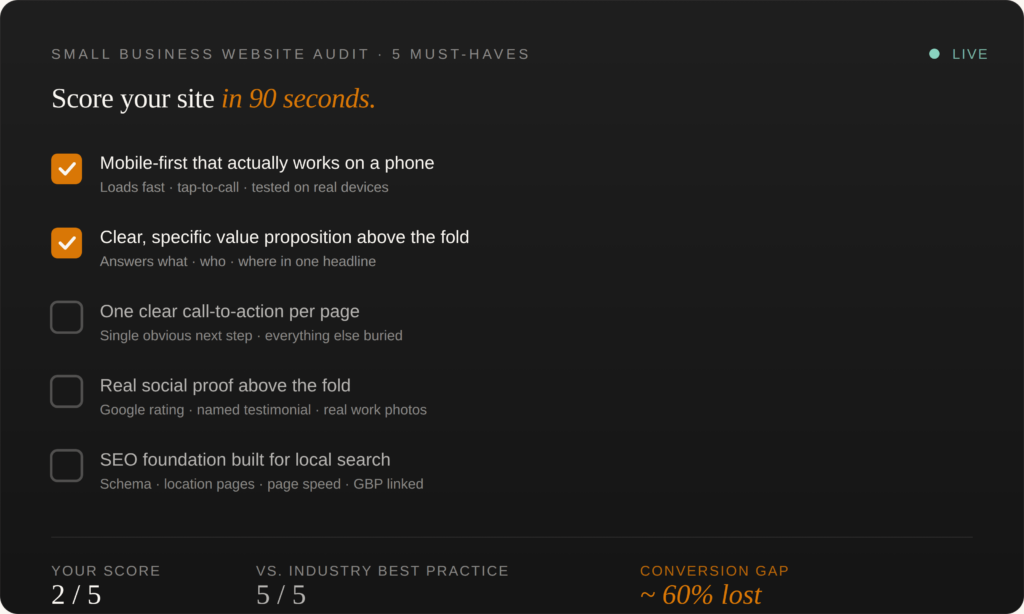
Score your site as you read
Tap each item below as you confirm your site has it. The amber score in the corner updates live so you can see where you stand by the end.
2026 Website Checklist · 5 Items
Score your site as you read.
1. Mobile-first that actually works on a phone
There’s a test I run on every audit before I open Lighthouse or Search Console. I pick up my own phone, not a desktop browser shrunk to mobile, walk outside the office on Tank Farm Road where the LTE is mediocre, and start a stopwatch. From the moment I tap the search result, how long until I can actually call the business? More than five seconds and two taps, the site is leaking money.
Mobile is 65% of website traffic in 2026 on average. On the local-service sites I track around SLO and the Five Cities, the real number is closer to 78%. Most of my clients’ visitors aren’t sitting at a desk weighing tree-care quotes. They’re standing in the front yard staring at a dead branch.
Three things fail this test most often. A phone number rendered as plain text instead of a tap-to-call link. A contact form with seven fields and a CAPTCHA. A hero image that takes four seconds to render on cellular because nobody compressed it. Fix those three and you’ve usually moved the needle on conversion before touching anything else.
2. A clear, specific value proposition above the fold
Open your homepage in a fresh tab. Read just the first headline.
It should answer three things in one sentence: what you do, who it’s for, and where. “Welcome to our website” answers nothing. “Trusted Central Coast service since 2003” fills space. “Custom kitchen remodels for SLO County homeowners, built in your home in six to eight weeks” actually does the job.
Vague feels safe. It isn’t. Specific feels like you’re cutting prospects off at the door. You aren’t, you’re just selecting the right ones up front. The wrong-fit leads were going to waste your time anyway.
3. One clear call-to-action per page
This is the most common conversion mistake I see on local-business sites. Five CTAs all competing on one page. Get a quote. Book a consultation. Request more info. Newsletter signup. Follow us on Instagram. When a visitor sees five doors, the most popular choice is none.
Every page on your site has one job. The homepage’s job is usually “request a quote.” A service page’s job is usually “call.” A blog post’s job is usually “download the guide” or “book a free audit.” Pick the one job, repeat the CTA at three points in the page (above the fold, mid-scroll, footer), and demote everything else. The newsletter signup goes in the footer. Instagram goes in the footer. Save your visitor the cognitive load of choosing.
Single-purpose pages convert harder than general homepages because of this. The median landing page conversion rate is 4.02% versus 2.35% for general site pages in 2026. Same offer, same audience, just one door.
Last year I rebuilt a paid-ads landing page for a Central Coast brokerage. Three CTAs got pulled to one. Two paragraphs of company-history filler got cut. The form went from seven fields to three. Same traffic, same offer. Cost per lead dropped meaningfully and lead quality went up because fewer tire-kickers were filling it. That brokerage closed 2025 with over 3,500 leads through their site.
4. Real social proof above the fold
Most local-business sites I audit have nothing above the fold. No reviews. No client names. No photos of actual finished work. The visitor lands and has zero evidence anyone has ever trusted you with a check.
What I look for in the first viewport: a Google rating with the review count alongside it. The count matters more than the score. “4.9 from 142 reviews” beats “5.0 from 8 reviews” every time, because volume signals years of real work, not just your aunt and your last three jobs. Then a single named testimonial. First name and last initial, ideally a photo, ideally one specific sentence that couldn’t have been written by a marketing agency. Then proof of local work. A photo of an actual project in a recognizable spot. A SLO bathroom remodel with the Madonna Inn skyline in the window beats a stock photo of granite countertops every time.
Stock imagery is the giveaway. Visitors are scanning for evidence you actually work where they live, not somewhere abstract.
5. SEO foundation built for local search
SEO is structural, not cosmetic. Same as plumbing in a house. You can’t bolt it on later without ripping the walls open.
The non-negotiables for local SEO in 2026, in the order I check them. LocalBusiness schema on every page. Location-specific landing pages, with actual pages for SLO, Pismo, Paso, Atascadero where you serve, not “we serve the Central Coast” as a single line on the homepage. Page speed under two seconds on a real cellular connection (not your office wifi). H1 and meta description filled out on every URL. And the one most people miss: your Google Business Profile linked to a city-specific landing page on your site, not the homepage.
That last one matters more than people realize. Linking your GBP to a city-specific landing page rather than your homepage creates a stronger relevance signal between profile and site. If your GBP says you’re in San Luis Obispo, the destination page should say so too, not the page that talks about every city you might serve.
Most sites I audit fail three of these five. The fix isn’t always a rebuild. Sometimes it’s an afternoon of schema cleanup, one new landing page, and a properly compressed hero image. Worth checking before you assume you need a whole new site.
How to read your score
5 of 5: You’re already in the top decile of small-business sites I see in this market. Spend your time on traffic acquisition and conversion-rate optimization, not foundation work.
3 to 4 of 5: Solid foundation, one or two visible gaps. The missing items are usually the highest-leverage things you can fix this quarter. Tackle them in order. Mobile and social proof first, almost always.
1 to 2 of 5: Your site is working against you. Visitors who arrive aren’t converting and search isn’t sending you what it should. The good news: this is fixable without starting from scratch. I’ve turned around sites at this score with a sprint of structural cleanup and a tighter homepage.
0 of 5: The site exists but isn’t doing the job. Probably time to start fresh, with a foundation built around what I just walked through and not around what looks pretty in a Figma file.
Want me to actually score your site against this checklist?
I’ll review your site against all five must-haves and send you a written audit with specific fixes prioritized by impact. No obligation, no pitch.
Get a free strategy audit →