
What Should San Luis Obispo Businesses Spend on Google and Meta Ads? (2026)
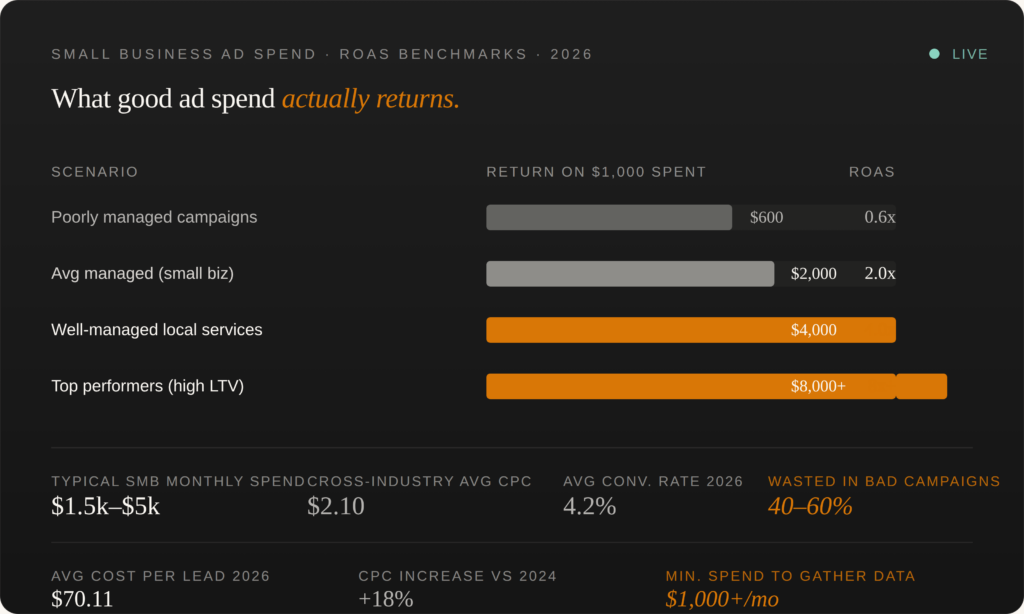
“How much should I spend on ads?” is the second-most-asked question I get from SLO business owners (right after “what should a website cost?”). The honest answer is: it depends on your industry, your customer value, and whether you have the foundation to convert the traffic. But there are real benchmarks. Here’s what the data says about Google and Meta ad spend in 2026 — and a calculator to figure out what makes sense for your business.
The honest spending ranges for small businesses in 2026
For most small businesses generating consistent results from Google Ads in 2026, monthly spend lands in three buckets:
Starting / testing phase: $500 to $1,500 per month. Enough to gather initial data in moderately competitive markets. Below this you don’t have enough conversion data for the algorithm to optimize, and you’re paying for clicks without learning much.
Active lead generation: $1,500 to $5,000 per month. The most common range for small businesses seeing real ROI. Per Searchlab’s 2026 benchmark data, this is where the majority of small business spend sits and where most local service businesses become profitable.
Competitive markets or high-value services: $3,000 to $10,000+ per month. Necessary for industries like legal, healthcare, real estate, and finance where CPCs are high and competition is fierce. Below this in those categories you’ll get outbid into oblivion before lunch.
Cost-per-click reality check by industry
The “Google Ads costs $X per click” answer is meaningless without your industry. Here are the real 2026 averages so you can see where you stand:
Legal services
$8.58
Home services
$7.85
Dental / medical
$7.85
Insurance
$5.25
Professional
~$5.00
E-commerce
$3-4
Restaurants
$2.05
Cross-industry avg
$2.96
CPCs are up roughly 12-13% compared to 2024, driven by increased competition and AI-powered bidding strategies. The plumber paying $7.85 per click for a $500 job has great margins. The cleaner paying $10 per click for a $100 recurring service needs to retain customers for months to break even. Know your numbers before you start.
The ROAS calculator — what does your spend need to return?
Plug in your numbers to see what kind of return you’d need to justify the spend. The defaults reflect typical home services economics in SLO County.
ROAS Calculator
What you need to break even and grow
Monthly Clicks
Customers To Break Even
Customers For 3x ROAS
Assumes you’re tracking conversions correctly. If you’re not, you have a measurement problem before you have a spend problem.
What good ROAS actually looks like in 2026
The broad average for well-managed small business Google Ads campaigns is 2x to 4x ROAS — meaning $1,000 in ad spend produces $2,000 to $4,000 in revenue. For local service businesses with high job values and clear conversion paths, 5x to 10x is genuinely achievable when the campaigns are structured well.
The businesses that get this kind of return aren’t doing magic. They’re doing the unglamorous fundamentals: tight keyword targeting, exhaustive negative keyword lists, dedicated landing pages instead of homepage traffic, and conversion tracking that actually works. Poorly managed campaigns waste 30 to 40% of their budget on irrelevant clicks. Well-managed ones generate $3 to $8 for every dollar spent.
Google vs Meta — when each one wins
Google Ads and Meta Ads (Facebook + Instagram) are different products solving different problems. Most small businesses default to Google because the intent is stronger, and they’re usually right — but it depends on what you sell.
Google Ads wins when people are actively searching for your service. “Plumber near me” is a Google ad. Someone typing that phrase needs a plumber within hours. The intent is enormous, the conversion rates are high, and the CPCs reflect both. For service businesses, professionals, healthcare, home services — Google is the primary channel.
Meta Ads wins when people don’t know they need you yet. A boutique selling handmade jewelry, a winery announcing a new release, a local restaurant promoting a new menu — those work better on Meta because they create demand rather than capturing it. Meta lets you target by demographics, interests, and lookalike audiences. The cost-per-click is lower than Google but the intent is also lower, so conversion rates are lower too. The math still works for the right business.
Most local service businesses in SLO should start with Google. Most retail, hospitality, and lifestyle brands should start with Meta. The smartest businesses run both eventually, but pick the one that matches your business model first.
The hidden cost — management fees
The ad spend itself is only part of the total cost. In 2026, agency management fees typically range from 10 to 20% of ad spend, often with a monthly minimum of $750 to $5,000. Most small businesses paying $2,500/month in ad spend are also paying $400 to $1,000/month in management fees. Total real cost: closer to $3,000 to $3,500.
The question of whether to manage in-house or hire someone comes down to time and expertise. If you have neither, paying a competent professional 15-20% to handle it pays for itself within a few months because they catch the budget killers above. If you have time and willingness to learn, you can manage your own campaigns — but expect a 6-month learning curve before performance stabilizes.
The order of operations that actually works
If you’re a SLO business considering paid ads in 2026, here’s the order I’d recommend:
First, fix conversion tracking. Without it you’re guessing. Get GA4 set up, conversion events firing on form submits and phone calls, and a dashboard that shows what’s actually generating leads. This is non-negotiable.
Second, build dedicated landing pages. Every ad campaign should send traffic to a page built for that specific service and audience, not your homepage. The conversion lift from this single change is usually 2-3x.
Third, start with $1,500 to $2,500 per month. Run campaigns for 60-90 days minimum. The first 30 days are learning. The next 30-60 are optimization. Pulling budget at month 4 because “it’s not working” usually means you didn’t give it long enough.
Fourth, scale what’s working. Once you have 2-3 months of data and you can clearly see what’s profitable, double down. The campaigns that work compound. The ones that don’t get killed.
The biggest mistake I see SLO businesses make
Underspending. Specifically, businesses that put $300 to $500 per month into ads, see no results in 30 days, and conclude “ads don’t work for our business.” What actually happened is they didn’t spend enough to gather meaningful data. A campaign needs at least 30-50 clicks per keyword per month before Google’s algorithm gathers enough data to optimize anything. At $5 per click, that’s $150-$250 per keyword per month — just to reach the learning phase.
If you can’t commit at least $1,000 per month to ad spend for at least three months, don’t start ads yet. Spend that money on improving your website and Google Business Profile first. The foundation has to work before paid traffic to it can convert.
Wondering if you’re overspending or underspending?
I’ll review your current campaigns (or assess whether ads make sense for your business if you’re not running them yet) and send you a written audit with what to adjust. Free, no pitch.
Get a free strategy audit →