
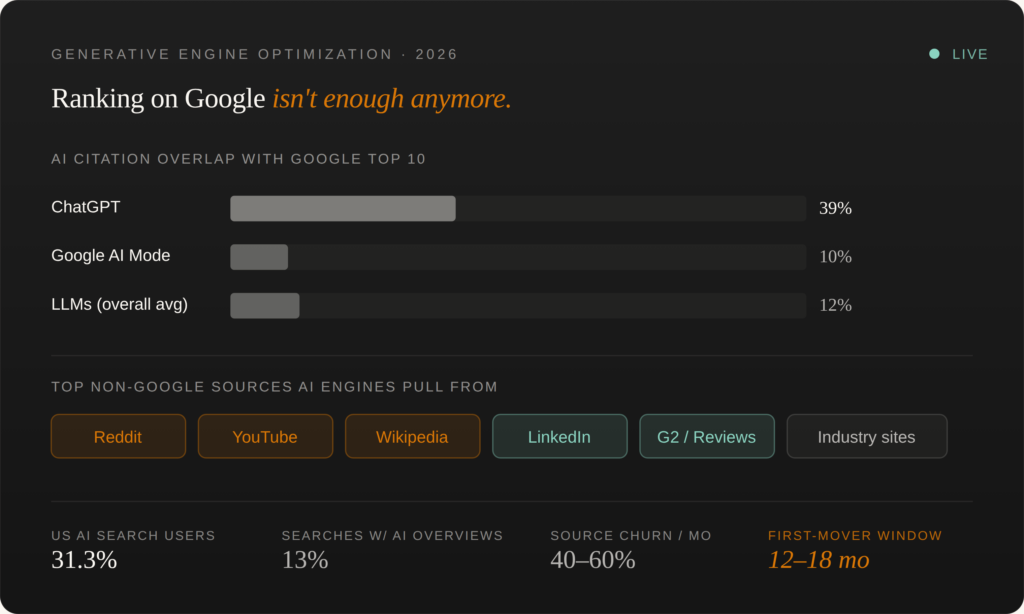
Here’s a stat that should rearrange how you think about search: only 12% of the URLs cited by AI tools rank in Google’s top 10 for the same question. Translation — being #1 on Google doesn’t mean you’re cited by ChatGPT. The two systems are diverging fast, and most California businesses are still optimizing for only one of them. This is the playbook for showing up in both.
The shift that’s already happening
If you’ve Googled anything in the last six months, you’ve already seen it. AI Overviews — those generative summaries at the top of Google results — show up on more searches every month. ChatGPT, Perplexity, Gemini, and Claude are answering questions directly without sending people to websites. Buyers research first in conversation, second in blue links.
US AI Search Users 2026
31.3%
Roughly 1 in 3 Americans now use generative AI search regularly
Google Searches With AI Overviews
13%
Up from 6.5% in January 2025 — doubled in one year
Health Queries With AI Overviews
17%
Some categories are already past the inflection point
The acronym for optimizing for this new layer is GEO — Generative Engine Optimization. Some people call it AEO (Answer Engine Optimization) or LLMO (Large Language Model Optimization). The terminology hasn’t settled, but the practice is real: structuring your content so AI systems can find it, understand it, and cite it when they answer questions about your category.
Why ranking on Google isn’t enough anymore
This is the part that catches business owners off guard. You’ve been told for years that the goal is to rank in Google’s top 10. That’s still useful, but it doesn’t translate cleanly to AI search.
According to research compiled by Foundation Inc., only about 10% of AI Mode citations match Google’s organic results. ChatGPT’s chosen sources overlap with Google 39% of the time. And just 12% of URLs cited by LLMs rank in Google’s top 10 for the original prompt. Each AI system pulls from a different mix of sources, and that mix is constantly shifting — between 40% and 60% of cited sources change month-to-month across Google AI Mode and ChatGPT.
That instability is uncomfortable, but it’s also the opportunity. Most California small businesses are doing nothing for AI visibility. Whoever moves first in their category gets cited disproportionately because there’s so little competition for the citation slots.
Where AI engines actually find their answers
If you assumed AI just rewords what’s on Google, you’d be missing most of the picture. AI engines pull from very different source mixes — and the surprise is how much weight community platforms carry.
Where AI Engines Pull Answers From
Top sources cited by major LLMs in 2026
This is why GEO isn’t just on-page SEO with a new name. eMarketer’s analysis confirms Reddit, LinkedIn, and YouTube ranked among the most-referenced domains by major LLMs in late 2025. Your website matters, but so does whether your business has been mentioned in places AI considers trustworthy. A plumber who shows up in three Reddit threads about local plumbers in their metro is more likely to be cited by ChatGPT than one who’s only on their own website, even if that website ranks #1 on Google.
How AI search reads content differently
Traditional SEO rewards comprehensive, deep content with lots of context. GEO rewards content that’s structured so an AI can extract a clean answer from the first 200 words. The shift is from “build context” to “answer first, then explain.”
If you write a blog post titled “How much does HVAC repair cost in Sacramento?” — the old SEO instinct is to spend 300 words on history of HVAC, then 500 words on factors that affect cost, before finally giving a price range buried at the bottom. That structure still ranks on Google. But AI search will skip past it and cite a competitor who answered the question in the first paragraph.
Score your AI visibility readiness
Here are the eight things that materially affect whether AI systems will cite your business in 2026. Tap each item your site already has dialed in. The score updates as you go.
2026 GEO Readiness Audit · 8 Items
Score your AI search readiness.
The honest read on what to do this quarter
If you scored 5 or higher, you’re already ahead of most California small businesses. Focus on items 4 and 5 — external mentions and original data — because those compound the most over the next 12 months.
If you scored 0 to 4, the quickest wins are usually structural: rewrite the openings of your top 5 pages to lead with answers, add a real author bio with credentials to your blog posts, and audit your current AI visibility by literally typing “best [your service] in [your city]” into ChatGPT and Perplexity. That single audit takes 10 minutes and is more revealing than most paid SEO reports.
What GEO is not
It’s not a replacement for SEO. Brands that excel at GEO in 2026 are typically the same brands with strong traditional SEO foundations. The optimization principles overlap significantly — clean technical SEO, authoritative content, fast page speed, structured data — but GEO adds specific requirements around content structure, citation-friendliness, and external presence that pure SEO doesn’t address.
It’s also not magic. The first-mover advantage will close. 55% of enterprise buyers already use AI to begin their search; nearly half use it for market research. The window where this is uncrowded for small businesses is the next 12 to 18 months. After that, AI search optimization will be table stakes the way mobile-friendly was by 2018.
The California businesses that figure this out early will own disproportionate visibility for years. The ones who wait until everyone else is doing it will spend the next decade trying to catch up.
Want to see what AI says about your business right now?
I’ll run an AI visibility audit for your business — checking ChatGPT, Perplexity, Gemini, and Google AI Overviews — and send you a written report on where you appear, where you don’t, and the highest-impact actions to take. Free, no pitch.
Get a free AI visibility audit →