
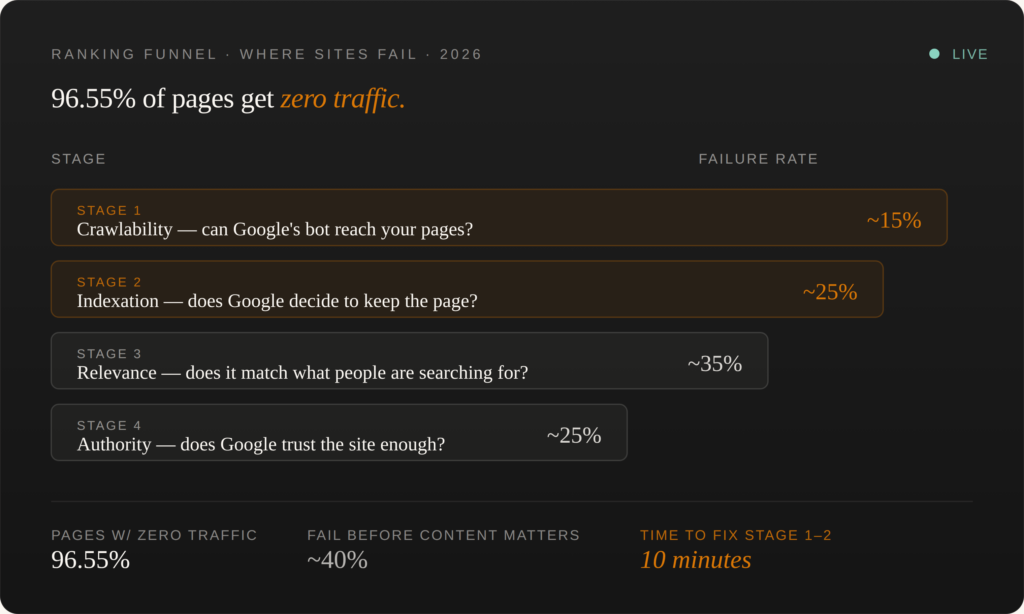
If your website isn’t ranking, you’re not alone — 96.55% of all web pages get zero organic traffic from Google, according to an Ahrefs analysis of 14 billion pages. The good news is that the reasons are diagnosable and fixable. Most ranking problems trace back to one of four stages, and in 90% of the audits I’ve run, the issue is happening earlier in the chain than the business owner thought.
The four stages every page has to clear before it can rank
Before a page can rank, it has to pass four sequential tests. Most diagnostic guides skip stages 1 and 2 because they assume the basics are working — but those are exactly where the most expensive mistakes hide. A page can’t rank for content quality if Google has never indexed it.
The Ranking Funnel
Where most sites quietly fail.
Crawlability
Can Google’s bot reach your pages? Robots.txt, blocked URLs, broken links
Indexation
Does Google decide to keep the page? Noindex tags, thin content, duplicates
Relevance
Does the page actually match what people are searching for? Intent mismatch is the #1 culprit
Authority
Does Google trust the site enough to rank it? Backlinks, brand signals, age
Notice that 40% of the failures happen in stages 1 and 2 — before content quality even matters. Yet most “why isn’t my site ranking” advice jumps straight to writing better content. That’s like telling someone whose car won’t start to upgrade their sound system.
Diagnose your ranking problem in 4 questions
Answer these honestly. The tool below will tell you the most likely cause and the specific fix. The questions go in order — early stages take priority because nothing downstream matters if an earlier stage is broken.
Ranking Diagnostic · 4 Questions
What’s actually wrong with your site?
1. When you search site:yourdomain.com on Google, do all your important pages show up?
2. Do your service pages have at least 500 words of unique, specific content?
3. When you search your target keyword, are the top results the same kind of page as yours? (e.g., listicles vs. service pages vs. comparisons)
4. Does your site have backlinks from at least 5 other websites pointing to it?
Likely Diagnosis
—
—
The five most common ranking killers (and what to actually do about each)
1. Pages aren’t indexed (the silent killer)
This is the audit finding that catches business owners most off-guard. In one audit, an entire blog was accidentally set to noindex during development — six months of content Google literally couldn’t read. The site owner had no idea why traffic was flat.
The fix takes 10 minutes. Open Google Search Console (free), go to the Pages report, and check how many of your pages are indexed vs. excluded. If important pages are excluded, the report will tell you why — usually a noindex tag, a redirect, or a robots.txt block. Fix the cause, then use URL Inspection to request reindexing. Most pages are back in the index within a week.
2. Intent mismatch (the #1 cause of “good content that won’t rank”)
You wrote a 2,000-word article on “best CRM software for small business.” It’s well-written. It still doesn’t rank. Why? Because Google decided the searcher wants a side-by-side comparison with pricing, not an educational explainer — and your page is the explainer.
The fix is humbling. Search your target keyword in an incognito tab. Look at the top 10 results. What format are they? Comparison tables? Listicles? Step-by-step guides? Service pages? That’s the format Google has decided wins. Rebuild your page to match — same depth, same format, better execution. Don’t try to win by being different. Win by being better at the same thing.
3. Core Web Vitals — when speed becomes a ranking ceiling
Google’s Core Web Vitals — Largest Contentful Paint (LCP), Interaction to Next Paint (INP), and Cumulative Layout Shift (CLS) — are direct ranking signals. Pages ranking at position 1 are 10% more likely to pass Core Web Vitals than those at position 9.
The 2026 targets: LCP under 2.5 seconds, INP under 200ms, CLS below 0.1. Test your site free at PageSpeed Insights. The most common causes of failure: uncompressed images, too many third-party scripts (chat widgets, tracking pixels, ad code), slow hosting, and no CDN. None of those are difficult to fix individually — they just need someone to actually do them.
4. Targeting keywords you can’t realistically win
A new business in San Francisco isn’t going to outrank national franchises for “plumber” in year one. Not because SEO doesn’t work — but because those competitors have years of authority, thousands of pages, and massive backlink profiles. Competing head-on against them with broad keywords is a multi-year effort.
The fix: pivot to long-tail. Instead of “plumber san francisco” go after “tankless water heater installation noe valley” or “emergency drain cleaning richmond district.” Lower volume, much higher conversion intent, and far less competition. Target keywords with search volume above 100/month and difficulty under 20 for the first six months. Win those, build authority, then climb to the broader terms.
5. The patience problem (you’re not failing, it’s just early)
SEO doesn’t work like Google Ads. There’s no “I turned it on Monday and got leads Tuesday.” Most SEO improvements take 60-90 days for content changes, 60-120 days for backlink work to show up, and 4-8 months for competitive keywords to move into top positions. Technical fixes can show in days; content takes months; authority takes longer still.
Most businesses I’ve watched abandon SEO at month 4 — the moment right before it would have started working. The compounding effect is real but it requires consistent investment for at least 9-12 months before the curve accelerates. If you’re at month 3 and not seeing movement, that’s normal. If you’re at month 9 and still flat, that’s a strategy problem, not a patience problem.
The diagnosis tree, summarized
Work through these in order. Don’t skip ahead. The earliest broken link in the chain is the one that matters first.
Step 1 — Indexation check. 10 minutes in Google Search Console. Are your important pages indexed? If not, fix that first. Nothing else matters.
Step 2 — Content depth check. 30 minutes scrolling your own site. Does each service page have at least 500 words of unique, specific content? If not, that’s your next priority.
Step 3 — Intent match check. 5 minutes per keyword. Search your target term. What format are the top 10 results? Does your page match that format? If not, restructure.
Step 4 — Technical check. Run PageSpeed Insights. If you’re failing Core Web Vitals, fix the obvious issues first (image compression, script trimming).
Step 5 — Authority check. Use Ahrefs Backlink Checker (free version) or Google Search Console’s Links report. If you have fewer than 5 referring domains, that’s your bottleneck.
Most businesses find their answer at step 1, 2, or 3. The expensive ones to fix — authority and competition — only matter when you’ve already cleared the foundations. If you skip ahead and start “building backlinks” before fixing indexation, you’re just spending money to amplify a broken page.
Want me to diagnose your site for you?
I’ll run through all five stages on your actual site and send you a written audit with the specific fixes prioritized by impact. Most audits surface 2–3 issues the business owner didn’t know existed. Free, no pitch.
Get a free strategy audit →