
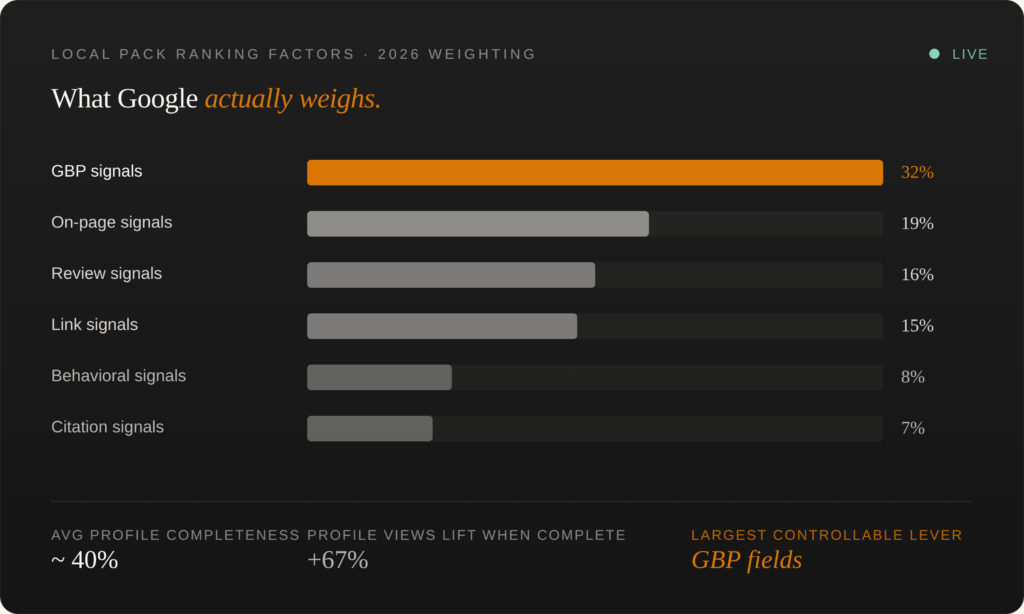
If you do nothing else for your local visibility this year, fix your Google Business Profile. GBP signals account for 32% of local pack ranking factors in 2026 — more than backlinks, more than reviews, more than your website’s on-page SEO. And most small businesses I audit have profiles that are 40% complete. The gap between “claimed” and “fully optimized” is where the local pack gets won.
What actually moves rankings in 2026
Forget the old advice about geotagging your photos and stuffing keywords in your business name. Most of that has been debunked. Whitespark’s 2026 Local Search Ranking Factors survey shows the real weight of each ranking factor — and it’s clarifying.
2026 Local Pack Ranking Weight
What Google actually weighs for local rankings
GBP signals are the highest-leverage area you can directly control. On-page SEO matters, reviews matter, but the profile itself is the foundation. Get that right and the rest amplifies. Get it wrong and nothing else compensates.
Step 1 — Pick the right primary category (the single biggest lever)
According to the 2026 ranking survey, primary category is the #1 GBP factor for local pack visibility. Not the second. The single biggest. And most businesses get it wrong.
The mistake: choosing a broad, generic category that “feels” right. The fix: choosing the most specific category that accurately describes what you do. A “Plumber” who specializes in tankless water heaters might rank better as “Water Heater Supplier” if that’s primarily what they sell. A “Roofer” who only does residential work might rank better as “Roofing Contractor” with “Residential” attributes set.
You can also add up to 9 secondary categories. Use them. If you’re a chiropractor who also does massage therapy, both should be listed. If you’re a coffee shop that’s also a wine bar in the evenings, both should be listed. Each secondary category opens you up to a new pool of searches.
Step 2 — Complete every single field (yes, all of them)
Google rewards completeness. Businesses that actively manage all profile features see 67% more profile views and 43% more website clicks compared to basic listings. Most small businesses have a profile that’s filled out about 40%. Get yours to 100%.
- Business name — exactly as it appears on your signage and legal docs
- Primary category + up to 9 secondary categories
- Address (or service area if you don’t have a physical location)
- Phone number — same one used everywhere else online
- Website URL — link to a city-specific page if you have one, not the homepage
- Hours — including holiday hours and special hours when relevant
- Business description — 750 characters with relevant keywords woven in naturally
- Services list — every service with a description and price if applicable
- Products list — for retail, this matters a lot
- Attributes — wheelchair accessible, free wifi, women-owned, etc.
- Photos — exterior, interior, team, products, before/after work
- Q&A — pre-populate common questions with answers (you can ask and answer your own)
The services list is where most people leak ranking opportunity. Every individual service should have its own entry with a description. If you’re a contractor, “kitchen remodel,” “bathroom remodel,” and “whole-home remodel” should all be separate entries with their own keyword-rich descriptions.
Step 3 — Build a review velocity system
The math has shifted in 2026 toward review recency and velocity over total review count. A business with 200 reviews and none in the past six months now ranks below a business with 80 reviews and a steady weekly flow. Stagnant beats nothing, but consistent beats stagnant by a wide margin.
The system that works: review requests built into your service delivery process. After every completed job, every closed deal, every checkout — a request goes out. Not “please review us when you have time.” A specific, easy ask: text message with a direct link to your review page, sent the same day the work was completed. The friction needs to be near zero.
Respond to every review. Yes, every one. Negative reviews especially — your response is your audition for everyone else reading. Businesses that respond to 80% or more of reviews see a measurable ranking boost, and the response is also the single most powerful conversion tool you have. A future customer reading a 1-star review followed by a calm, professional response from the owner reads “this is how they handle problems” — which is more important to them than the original complaint.
Step 4 — Photos as a ranking factor (and a conversion tool)
Photos drive both rankings (through engagement signals) and conversions (through trust). Most small businesses have 5-10 stock photos and a logo. The goal is 50+ original photos covering everything: exterior, interior, team, work in progress, finished projects, products, behind the scenes.
Add new photos consistently. A few new photos per month signals freshness to Google’s algorithm. It also gives potential customers something new to look at every time they revisit your profile. The businesses that update photos monthly outrank stagnant profiles even when other factors are equal.
One thing not to bother with: geotagging your photos. Google strips EXIF metadata including GPS coordinates from every photo on upload. The “geotag your photos for SEO” advice you’ll still see in some blog posts is from 2018 and has been debunked.
Step 5 — Use Posts (but understand what they actually do)
Google Posts — those announcement-style updates you can publish to your profile — don’t directly move rankings. A controlled study by Sterling Sky tracking 441 keywords found zero ranking movement from Google Business Profile posts. So why bother?
Because they help with the things rankings can’t deliver alone: click-through rate from the local pack (which is a behavioral signal that does affect rankings indirectly), engagement, and reasons for someone to pick you over a competitor. A profile with a recent post showing a current promotion or a new project converts better than a stagnant profile, even at the same ranking position.
Post weekly. Don’t overthink the content. A photo of a recent project, a seasonal note, a current offer, an answer to a common question. 200-300 characters. Done.
The 2026 mistakes that get profiles penalized
Google’s AI is significantly better at detecting manipulation than it was two years ago. The shortcuts that used to work now actively hurt your rankings — sometimes catastrophically.
Avoid these: keyword-stuffing your business name (e.g., “Mike’s Plumbing | Best Plumber San Luis Obispo”), buying or trading reviews, using duplicate listings to cover multiple service areas, hiring services that promise “guaranteed top 3” rankings (which usually means review manipulation), and fake or AI-generated review responses.
The risk isn’t just “this won’t help.” It’s profile suspension or hard ranking penalties that can take months to recover from. The penalty for being caught manipulating GBP in 2026 is significantly more severe than the temporary ranking lift you might gain.
The compound effect
Here’s the part nobody mentions: GBP optimization is one of the few digital marketing activities where the gains compound rather than decay. A well-optimized profile keeps generating traffic and leads month after month with minimal additional effort. The work is mostly upfront. The returns are perpetual.
If you’re a small business in San Luis Obispo or anywhere on the Central Coast, GBP is the single highest-leverage free thing you can do for your visibility this year. Most of your competitors haven’t done it. Be the one who does.
Want me to audit your Google Business Profile?
I’ll review your profile against every 2026 ranking factor and send you a written audit with specific actions ranked by impact. Most profiles I review have at least 8 missed opportunities. Free, no pitch.
Get a free strategy audit →