
SEO or Google Ads First? A 2026 Decision Guide for California Businesses
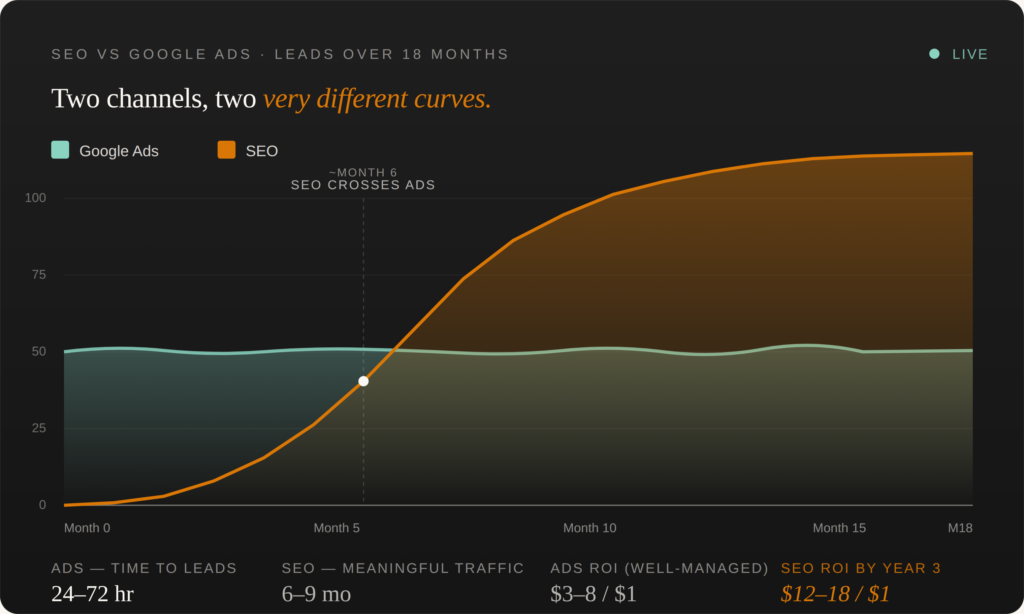
“Should I invest in SEO or Google Ads first?” is the question I get asked more than any other. The honest answer: it depends almost entirely on your timeline, your industry CPC, and how much patience your business has for compounding returns. There’s no universal right answer — but there is a right answer for your specific situation, and the math gets clearer than you’d think once you walk through four questions.
The fundamental trade-off
Google Ads buys you traffic. SEO earns you traffic. That’s the entire conceptual difference. Everything else — cost, speed, durability, predictability — flows from that one distinction.
When you turn on Google Ads, you can have qualified visitors on your site in 24 hours. When you stop paying, the traffic stops the same day. SEO is the opposite curve: nothing happens for weeks, then a slow build, and once you’ve earned a top ranking, that traffic compounds for years even if you reduce investment. The difference matters because most businesses pick the wrong one for their stage.
Channel A
Google Ads
Channel B
SEO
Take the decision quiz
Four questions. Each one matters more than industry blog posts let on. The recommendation at the end is what I’d tell you in a free strategy call given the same information.
Decision Quiz · 4 Questions
Where should your first dollar go?
1. How fast do you need leads?
2. What’s your monthly marketing budget?
3. What’s the typical Google Ads CPC in your industry?
4. Is your website ready to convert paid traffic right now?
My Recommendation
—
—
The four factors that actually decide it
1. Timeline (this is the biggest one)
If you need leads in 30 days, the answer is Google Ads. There’s no SEO strategy that produces meaningful traffic in 30 days for any competitive keyword. Even technical fixes that move existing rankings up a notch take a few weeks for Google to re-evaluate. New content takes 60-120 days minimum to rank for anything competitive.
If you can wait 6-12 months for the bulk of your traffic, SEO produces dramatically better economics. First Page Sage’s 2026 industry data shows organic search ROI averages 748% across professional services after the 9-month ramp, while paid search hovers in the 300-400% range — and SEO leads continue arriving long after the budget for that work was spent.
2. Industry CPC math
The average Google Ads click in 2026 costs about $2-4. But averages hide the truth. Home services run $7-10. Legal practice runs $9-20+ (personal injury can hit $50+ per click in California). Insurance, finance, and B2B SaaS sit in the $10-30 range.
Math the per-click cost against your conversion rate and customer value. If you’re a personal injury attorney in Los Angeles paying $50/click and converting 5% of clicks to leads at a 30% close rate, your CAC is $3,333. That works because case values are $25k+. If you’re a $300 service business paying the same numbers, you’re losing money on every click. Industries with high CPCs and low LTVs should lean SEO. Industries with high LTVs and tolerable CPCs can run both.
3. Site readiness (the multiplier)
This factor doesn’t get talked about enough. The best ad campaign in the world can’t fix a website that doesn’t convert. Average landing page conversion rates run 2-5% across industries; top-performing pages hit 10-15%. The difference between a 2% page and a 6% page is 3x more leads from the same spend. Same ads, three times the leads.
If your site is genuinely not ready — slow load times, no clear value proposition, hidden contact info, weak mobile experience — fix that before spending on either channel. The 6-week investment in conversion rate improvements often returns more than the next 6 months of ad spend.
4. Budget reality
Under $1,500/month, neither channel works well at scale. Pick one. Spreading $1,500 across both produces two anemic efforts that won’t generate enough data to optimize and won’t reach the volume threshold needed for SEO authority signals.
$1,500-4,000/month is enough for either channel to produce real results, but rarely both well. Sequence them: ads first if you need speed, SEO first if you have time, then layer in the other once you have data. $4,000+ is where running both well becomes possible — and it’s also where the compound effect of running both starts to matter (paid keyword data informs SEO content; SEO authority improves Quality Score and lowers ad costs).
The honest synthesis
Most California businesses I’ve worked with do better starting with Google Ads for the first 60-90 days, then layering SEO on top. Three reasons:
Reason 1: Cash flow. Most small businesses can’t survive 9 months of investment with no return. Ads produce immediate revenue that funds everything else.
Reason 2: Data. 60-90 days of paid search data tells you exactly which keywords convert for your business, what your average cost-per-acquisition is, and which landing pages turn clicks into leads. That’s a research budget for SEO work that would otherwise take 6+ months to gather organically. The best SEO strategy is one informed by paid data.
Reason 3: Compound advantage. Once SEO produces 30-50% of your leads, you can reduce ad spend, the cost-per-lead drops, and the ratio shifts further organic over time. By year 2-3, businesses doing both well typically have ad spend covering 20-30% of leads at a much lower cost-per-lead than a pure-play paid strategy.
The wrong move is treating it as a forever choice. It’s a sequencing decision. Almost every successful digital marketing strategy I’ve worked with for California small businesses runs both channels eventually — just not at the same time, and not in equal proportion.
Want a custom recommendation for your specific situation?
I’ll look at your industry, your market, your site, and your goals — and tell you exactly what I’d do if it were my marketing budget. Free, no pitch, written report you keep.
Get a free strategy audit →