
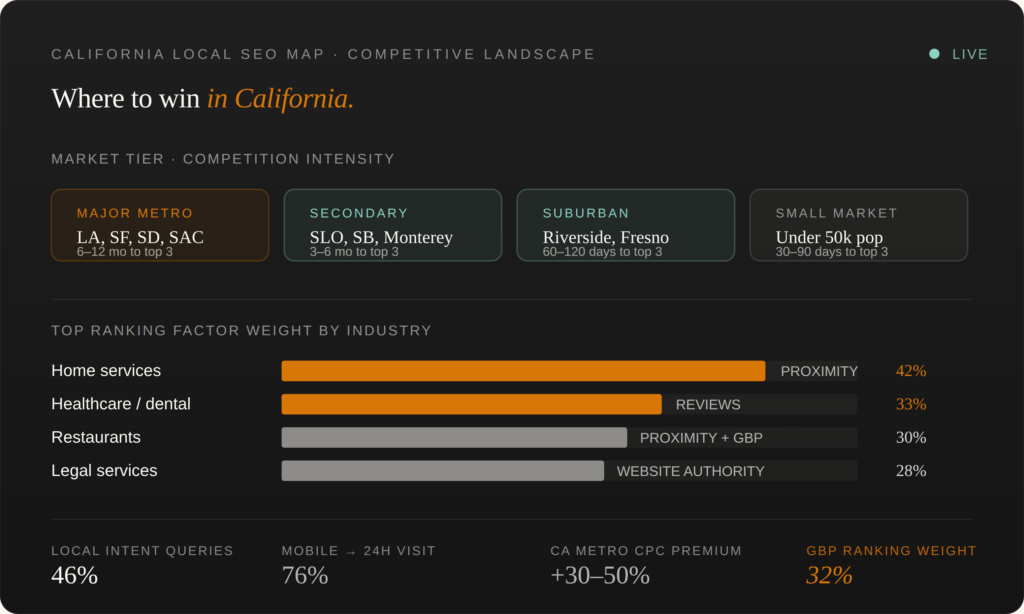
California is one of the most search-saturated markets in the country. 46% of all Google searches have local intent, and 76% of people who search for something nearby on their phone visit a business within 24 hours. Whether you’re a contractor in Sacramento, a dental practice in Irvine, or a winery in Sonoma — local search is the single biggest opportunity in front of you. Here’s the actual playbook for ranking in California in 2026.
Why California is harder (and more rewarding) than most markets
California’s local search environment has three characteristics that change the math. First, the metro density is extreme — LA, the Bay Area, San Diego, Sacramento, Riverside, and Fresno all have populations larger than entire states. The competition for any single search term is brutal in those metros. Second, secondary markets like Santa Barbara, San Luis Obispo, Monterey, and Palm Springs have unusually high purchasing power and diverse search audiences. Third, the cost-per-click for paid search runs 30-50% above national averages in top California metros, which makes organic local rankings disproportionately valuable.
Searches With Local Intent
46%
Nearly half of all Google searches are looking for something nearby
Mobile Local → Visit in 24h
76%
Local mobile searches convert to visits at extraordinary rates
CA Metro CPC Premium
+30–50%
Top California metros run well above national paid search averages
What 2026 ranking factors actually look like — and how they shift by industry
The biggest mistake I see in local SEO advice is treating it as one-size-fits-all. Whitespark’s 2026 Local Search Ranking Factors survey shows ranking factor weights vary significantly by industry: restaurants depend on balanced signals, healthcare and dental businesses see reviews dominate at 33%, home services rely heavily on proximity at 42%, and legal businesses lean on website authority. The factors that matter most for a Sacramento plumber are different from what matters for an Irvine dentist.
Pick your situation below. The tool will show you the top 5 priorities for that specific city + industry combination, ranked by 2026 weight.
Local SEO Priority Tool · Pick Your Combo
Your top 5 ranking priorities, ranked.
—
The five things every California local SEO strategy needs to nail
1. A Google Business Profile that’s actually complete
I covered this in detail in my GBP mastery post, but the headline is unchanged: GBP signals account for 32% of local pack ranking factors in 2026, and most California businesses I audit have profiles that are 40% complete. The single highest-leverage free action available to any small business is bringing the profile to 100% completion.
For California specifically: don’t underestimate secondary categories. A massage therapist in Pasadena who only has “Massage Therapist” as their primary category is missing out on searches for “Wellness Center,” “Sports Massage,” “Prenatal Massage,” etc. Each secondary category is a new search pool you can show up in.
2. City-specific landing pages, not just a “service area” page
If you serve multiple California cities, you need a dedicated landing page for each one. Not a list of cities at the bottom of your homepage. Actual pages with city-specific content, local imagery, neighborhood references, recent project examples, and ideally testimonials from clients in that city.
This is also where you should link your Google Business Profile. Don’t link your GBP to your generic homepage — link it to the city-specific landing page that matches the GBP location. The relevance signal between profile and page is significantly stronger when they’re geographically aligned.
3. A review velocity system, not a “we’ll ask sometimes” approach
Reviews are weighted heavily in 2026, but the math has shifted from total review count to review recency and velocity. A business with 200 reviews and none in the past six months now ranks below a business with 80 reviews and a steady weekly flow. Stagnant beats nothing, but consistent beats stagnant by a wide margin.
The system that actually works: review requests automatically built into your service delivery. Job complete → text message goes out same day with a direct link to your GBP review form. No “please review us when you have time” emails. Specific, easy, immediate. The friction needs to be near zero or it won’t happen consistently.
4. Local citations that actually exist (and are consistent)
NAP consistency — Name, Address, Phone matching exactly across the web — has dropped to about 7% of the local pack ranking weight, but it’s still meaningful. Inconsistent data weakens entity trust and can reduce ranking potential. Yelp, Bing Places, Apple Maps, Yahoo Local, the Better Business Bureau, your local Chamber of Commerce, industry-specific directories — they all need the same NAP info. Spelling out “Street” on one and “St” on another is a small inconsistency, but multiply it across 30 directories and Google starts hedging its trust.
For California businesses, the high-impact citations beyond the basics: California Lawyers Association (legal), CA Real Estate Association (realtors), specialty California-specific directories (like winecountry.com for wineries), local business journals, and chambers of commerce in every city you serve. Most paid citation services include the basics; what they often miss is the California-specific niche directories that actually move the needle.
5. Schema markup so search engines can read your pages cleanly
This is technical but worth doing. LocalBusiness schema, Service schema, FAQ schema, and Person schema (for service providers) help Google extract structured data from your pages. On-page SEO accounts for roughly 19% of local ranking weight, and the most impactful elements are LocalBusiness schema markup, location-specific title tags, and a fast mobile experience.
If you’re on WordPress, plugins like Yoast SEO or Schema Pro handle the basics. If you’re on a custom site, Schema.org has free generators that produce the JSON-LD you paste into your page head. Test it with Google’s Rich Results Test to confirm it’s parsing correctly.
The 90-day California local SEO sprint
If you’re starting from scratch and want to make real progress in 90 days, here’s the order of operations:
Days 1-14: Bring your GBP to 100% completion. All fields, all categories, photos, services list, hours, attributes. Audit citations and fix NAP inconsistencies.
Days 15-30: Build city-specific landing pages for your top 3-5 California markets. Real content, local imagery, testimonials. Update your GBP to link to the right one.
Days 31-60: Set up your review velocity system. Pick a tool (NiceJob, Birdeye, even a manual SMS template) and build it into your service delivery workflow. Aim for 4-8 new reviews per month minimum.
Days 61-90: Schema markup audit and implementation. LocalBusiness, Service, FAQ schemas at minimum. Test with Rich Results Test. By end of 90 days you should be ranked for at least 3-5 secondary keywords in your primary city.
This is the foundation. Months 4-9 are where compound gains start to show. Most California businesses that do this consistently see the local pack movement they’re looking for between months 6 and 9. The ones who quit at month 3 because “it’s not working” are leaving the gains on the table.
Want a custom playbook for your California city + industry?
I’ll audit your local search visibility and send you a written report with the specific actions ranked by impact for your exact market. Free, no pitch.
Get a free local SEO audit →