
Medical practice SEO is different from other local SEO because the people searching aren’t browsing — they’re hurting, scared, or weighing a decision they can’t put off. The vocabulary they type into Google is wildly different from someone looking for a coffee shop or a plumber, and the trust threshold they need to clear before they’ll book is higher than almost any other local service category.
This post walks through what those patients are actually searching, the six ranking factors that move the needle for medical practices, what’s specifically different about competing on the Central Coast (San Luis Obispo and Santa Barbara counties), the four mistakes I see on almost every medical practice site I audit, and a self-scoring readiness audit at the end.
Why patient search behavior changes everything
Most local businesses get found at the bottom of a short funnel: someone needs a thing, they type it in, they pick from the top three results. A patient journey is longer, more anxious, and starts with a question they’re not sure how to phrase.
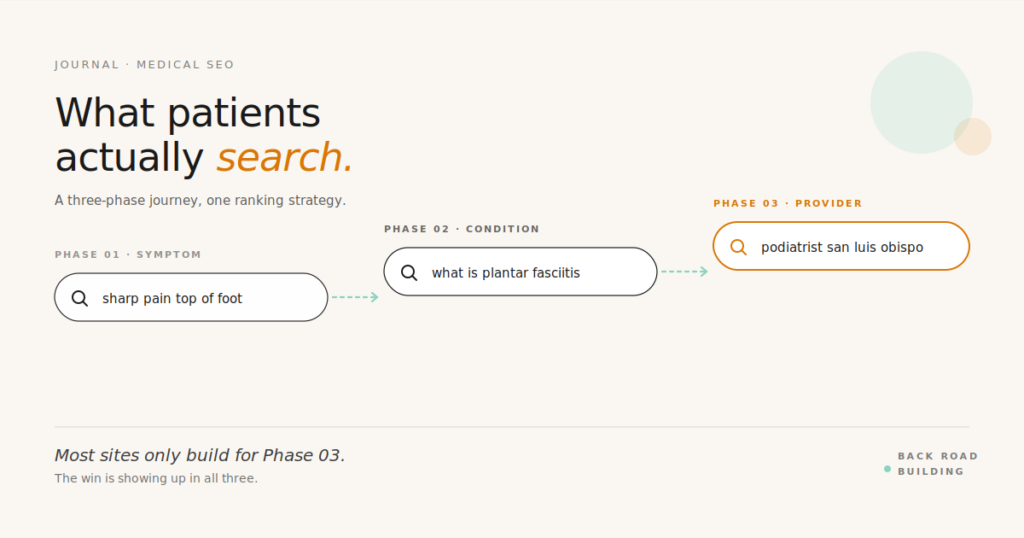
Here’s a real progression I’ve watched in search data and in patient interviews. Someone wakes up with sharp pain on the top of their foot. They don’t know what’s wrong. They don’t yet know they need a podiatrist. The search journey looks like this:
- Phase 1 — Symptom search: “sharp pain top of foot when walking,” “burning sensation in arch after running,” “ankle swelling no injury”
- Phase 2 — Condition research: “what is plantar fasciitis,” “extensor tendonitis treatment,” “stress fracture vs sprain how to tell”
- Phase 3 — Provider search: “podiatrist near me,” “best foot doctor san luis obispo,” “podiatry san luis obispo accepts blue shield”
Most medical practice sites are built only for Phase 3 — they have a homepage, a services list, a contact form. But Google sees the entire journey, and the practices that show up in Phase 1 and Phase 2 build trust before the patient ever looks at their competitors. By the time the patient gets to “podiatrist near me,” the practice that taught them what plantar fasciitis is has already won the appointment in their mind.
This is the single biggest strategic shift to make. Stop building for the booking page and start building for the questions that come before it.
The six ranking factors that move the needle for medical practices
Medical practice SEO sits inside Google’s YMYL category — Your Money or Your Life — which means Google holds medical content to a higher quality and authority standard than most other categories. That makes ranking harder, but it also means once you’re ranked, you’re harder to displace. Here are the six factors that earn that position.
1. Google Business Profile (the foundation, not the finish line)
Almost every other ranking factor compounds off a fully built Google Business Profile. For medical practices specifically, the fields that matter most are: primary category set to your specialty (not “doctor”), every applicable service listed individually under Services, every accepted insurance carrier listed in attributes, current photos of the actual practice (not stock photography), and accurate hours including any urgent care or after-hours availability.
The trap most practices fall into: setting up the profile once, picking the broadest category (“Medical Clinic”), uploading a logo, and walking away. A profile in that state will technically rank, but it’ll lose every meaningful comparison to a profile that’s built out specialty by specialty. The full GBP playbook is detailed in the GBP Mastery guide, but the medical-specific moves are: pick the most specific primary category Google offers (e.g., “Podiatrist” not “Doctor”), enable messaging if your front desk can respond same-day, and request reviews after every appointment, not in monthly batches.
2. Service-specific landing pages, not a generic services list
This is where most medical practices lose Phase 1 and Phase 2 search traffic without realizing it. A single page titled “Services” that lists fifteen treatments in a bullet list ranks for none of them. A page per condition — plantar fasciitis, ingrown toenail, diabetic foot care, sports injuries — ranks for each one individually and captures patients in the research phase.
The structure that works: each condition gets its own URL (e.g., `/conditions/plantar-fasciitis`), a real-language explanation of what the condition is, common symptoms, treatment options, what to expect at the first visit, and a clear next step. No fluff, no boilerplate. If you treat 20 conditions, you should have 20 condition pages. This is the foundation of medical content authority — and it’s also what AI search systems lift from when answering questions like “what does plantar fasciitis feel like.”
3. Reviews and the way you respond to them
Reviews matter more in healthcare than in almost any other category, because patients are picking someone they have to trust. The numbers themselves are a ranking factor, but the response patterns matter just as much — and HIPAA makes responding properly trickier than in other industries.
Here’s the rule that protects you, drawn from the AMA’s published guidance on physician responses to online reviews: never confirm or deny that someone was a patient — even if they self-identify as one in their review. The patient’s own disclosure does not give the practice permission to acknowledge the relationship. That’s a HIPAA violation, and the OCR has issued real fines for exactly this. A dental practice was fined $50,000 for posting anecdotal information about a patient interaction in a review response; a New Jersey mental health center was fined $30,000 for similar disclosures.
What you can do: respond in general terms about the practice’s policies and standards of care, without any acknowledgment of the reviewer. A response like “Thank you for the feedback. Our office is committed to careful, evidence-based care and clear communication with everyone who walks through the door.” reads as warm and substantive, signals quality to Google, and stays clear of HIPAA risk. Generic AI-sounding responses (“Thank you for your feedback! We appreciate your business!”) get pattern-recognized by Google and don’t carry the same weight as substantive ones.
For negative reviews — and every medical practice gets them — the move is to respond once, calmly, and move the conversation offline. Something like: “Thank you for sharing this feedback. We’d welcome the chance to talk through any concerns directly. Please call our office at [phone] when you have a moment.” Don’t engage in back-and-forth in public. Don’t try to win the argument. Future patients reading the response are evaluating your professionalism, not whether you were technically right.
4. E-E-A-T signals that prove who’s actually writing the content
Because medical content is YMYL, Google explicitly looks for signals that the people writing it have real expertise. The technical name for this is E-E-A-T — Experience, Expertise, Authoritativeness, Trustworthiness. For medical practices, the practical implementation is straightforward but rarely done well.
What to put on every condition or treatment page: an author byline with the doctor’s full name and credentials, a brief bio at the bottom of the page linking to a fuller bio elsewhere on the site, the date the content was last reviewed, and ideally a short statement of who reviewed it (“Reviewed by Dr. Smith, DPM, board-certified podiatrist”). The doctor’s full bio page should include education, board certifications, hospital affiliations, years in practice, and any teaching or research roles. These pages don’t need to be elegant — they need to be detailed.
If your bio page reads like a generic LinkedIn summary, Google has nothing to authenticate. If it reads like a CV, Google has the signals it needs to treat your content as authoritative.
5. NAP consistency and insurance directory citations
Name, Address, Phone consistency across the web is a baseline local SEO factor for any business, but for medical practices it has an extra layer: insurance carrier directories. Blue Shield, Anthem, Aetna, Kaiser, Tricare, the major Medicare Advantage plans — each has its own provider directory, and patients use them constantly to find in-network care.
If your practice’s NAP varies between Google, Yelp, Healthgrades, Vitals, Zocdoc, and your insurance directory listings, Google hedges its trust in your entity. Worse, patients calling the wrong number or showing up at the wrong address (an old suite from a relocation that’s still listed somewhere) creates real friction that turns into bad reviews. The fix is a one-time audit: pull your NAP from your website, check it against every directory you can find, and update the wrong ones. There are tools for this (BrightLocal, Yext, Whitespark), but for a single practice an afternoon of manual work covers the basics.
6. Medical-specific schema markup
Schema markup helps search engines parse your pages cleanly. For medical practices, the schemas that matter are MedicalBusiness (or the more specific subtype like Physician, Dentist, MedicalClinic), Service schema for each treatment, Person schema for each provider, and FAQ schema on condition pages.
If you’re on WordPress, Yoast SEO Premium and Rank Math both handle the basics. If you’re on a custom site or want more control, Schema.org has free generators for the JSON-LD you paste into the page head. Test it with Google’s Rich Results Test before considering it shipped — schema that doesn’t validate doesn’t help.
What’s different about competing on the Central Coast
Medical practice SEO in San Luis Obispo or Santa Barbara is not the same game as in Los Angeles or San Francisco. The competition density is lower, but the patient pool is smaller too, so absolute numbers can feel quiet even when ranking is strong. A few specifics that change the strategy.
Smaller markets are more dominable. The number of practices competing for “podiatrist san luis obispo” or “dermatologist santa barbara” is in the single digits in most specialties. That means breaking into the local pack is realistic with disciplined work over six to nine months — far faster than in a major metro. The flip side: total search volume is small enough that a single Phase 3 keyword might only generate 20 monthly searches, so the strategy has to win Phase 1 and Phase 2 traffic too.
Bilingual content is underused. A meaningful share of patients on the Central Coast — particularly in Santa Maria, Lompoc, and parts of north SLO County — search in Spanish or in mixed Spanish/English. Most medical practices don’t publish any Spanish-language content, which leaves an entire audience invisible to them. Even a single Spanish-language version of the most-searched condition page is a meaningful edge.
Service area boundaries matter. A practice in San Luis Obispo competes for searches in SLO city but also in Arroyo Grande, Pismo Beach, Atascadero, Paso Robles, Morro Bay, Los Osos, Nipomo, and Avila Beach. Each is its own search market with its own local pack. Generic “san luis obispo county” content doesn’t rank for “podiatrist arroyo grande.” City-specific landing pages do — but only when they’re real content, not the same page with the city name swapped in. Google catches templated pages quickly and devalues them.
The four mistakes that keep medical practices buried on page 2
I’ve audited dozens of medical practice sites and the same patterns show up almost every time.
Mistake 1 — One generic services page instead of per-condition pages. Already covered above, but worth repeating because it’s the single biggest miss. If your “Services” page lists 15 conditions and links to nothing, you’re invisible for all 15.
Mistake 2 — Hiding the doctor’s bio in the About page. Patient trust is the conversion variable in healthcare, and the doctor’s bio is the strongest trust asset on the site. It should be linked from the home page, from every condition page, and from the navigation. Burying it under About is a missed conversion lever and a missed E-E-A-T signal.
Mistake 3 — No insurance information on the site. “What insurance do you take” is one of the most common pre-appointment questions. If a patient has to call to find out, you’ve added friction that competitors who list insurance carriers prominently don’t have. List the major carriers you accept on the homepage, on the contact page, and on any condition page where coverage influences the decision.
Mistake 4 — Stale or absent review responses. A practice with 50 reviews and zero responses signals that nobody is paying attention. A practice with 50 reviews and thoughtful responses to most of them signals that the team cares. Both are visible to patients and both are visible to Google.
Score your practice’s medical SEO readiness
Eight items that materially affect whether your medical practice can rank for the searches that bring real patients in. Tap each item your practice already has dialed in. The score updates as you go.
2026 Medical SEO Readiness Audit · 8 Items
Score your practice’s readiness.
Where to start if your score was low
If you scored 0–3, the highest-leverage first move is the Google Business Profile rebuild. Two weeks of disciplined work on GBP will move more rankings than two months of content writing on a weak foundation. Then build out condition-specific pages, one per week, until every condition you treat has its own home on the site.
If you scored 4–6, you’re past the foundation. The remaining gains come from the items most practices skip — schema markup, doctor bio depth, and city-specific landing pages with real content. These are the items that separate first-page ranking from local-pack ranking.
If you scored 7 or 8, the work is no longer about catching up. It’s about staying out front: publishing one condition-specific piece a month, earning new reviews consistently, and watching Google Search Console for new query patterns to address. For a deeper read on why some practices rank quickly and others stall, the ranking diagnostic post walks through what to check when the work is done but the rankings haven’t moved yet.
Want a custom audit of your practice’s local SEO?
I’ll review your Google Business Profile, on-site content, schema, citations, and review patterns — then send you a written report with the specific actions ranked by impact for your specialty and location. Free, no pitch.
Get a free medical practice SEO audit →